Konfera

01. The Context
The Challenge
Organizers often struggle with fragmented tools that disconnect the planning phase from the live event execution, leading to low attendee engagement. Attendees, on the other hand, frequently feel like passive observers rather than active participants in virtual or hybrid environments. Konfera aims to bridge this gap by creating a unified ecosystem for seamless management and interactive participation.
Business Goal
To establish Konfera as the "all-in-one" solution for mid-to-large scale events, driving revenue through increased sponsor visibility and achieving high user retention by proving measurable attendee engagement (via polls and chat data).
User Goal
To reduce the administrative overhead of managing sponsors and event logistics through a centralized dashboard.
To feel connected and heard during events through intuitive social features and real-time interaction tools.
02. Execution
Design Process
I adopted a Mobile-First, Engagement-Centric approach. Understanding that attendees often use their phones while watching a live stream or attending in person, I prioritized a "lean-back" experience for viewing and a "lean-forward" experience for interaction. I utilized a modular design system to ensure the platform could scale from a small webinar to a massive multi-track conference.
Methods
Competitive Audit: Analyzing Zoom, Hoppin, and Eventbrite to identify friction points.
User Interviews: Speaking with 5 professional event planners about their biggest "day-of" stressors.
Surveying Attendees: Gathering data on why users typically "drop off" or go silent during digital events.
Persona Mapping: Creating distinct archetypes for the "Stressed Organizer" and the "Passive Attendee."
Target Users
Professionals, Attendees, Event Organizers, Event Marketers
Key Insights
The "Second Screen" Habit: Attendees want to chat without losing sight of the speaker/content.
Sponsor Friction: Sponsors feel undervalued if their branding is buried; they need prominent, non-intrusive placement.
Real-time Anxiety: Organizers need a "Global Control" view to manage live polls and chats instantly without navigating through multiple menus.
Process Stage
Discovery & Strategy
Defined the project scope, conducted stakeholder interviews to align on business KPIs, and audited the existing event-tech landscape.
Process Stage
User Research
Conducted 1-on-1 interviews and synthesized data into empathy maps to identify the primary pain points for both organizers and attendees.
Process Stage
Information Architecture
Mapped out the complex ecosystem of Konfera, ensuring a logical flow between the "Backstage" (Organizer) and the "Stage" (Attendee).
Process Stage
Wireframing & Prototyping:
Developed low-fidelity skeletons to test the placement of the "Interaction Sidebar" (Chat/Polls). Iterated into high-fidelity interactive prototypes in Figma.
Process Stage
Visual Design System
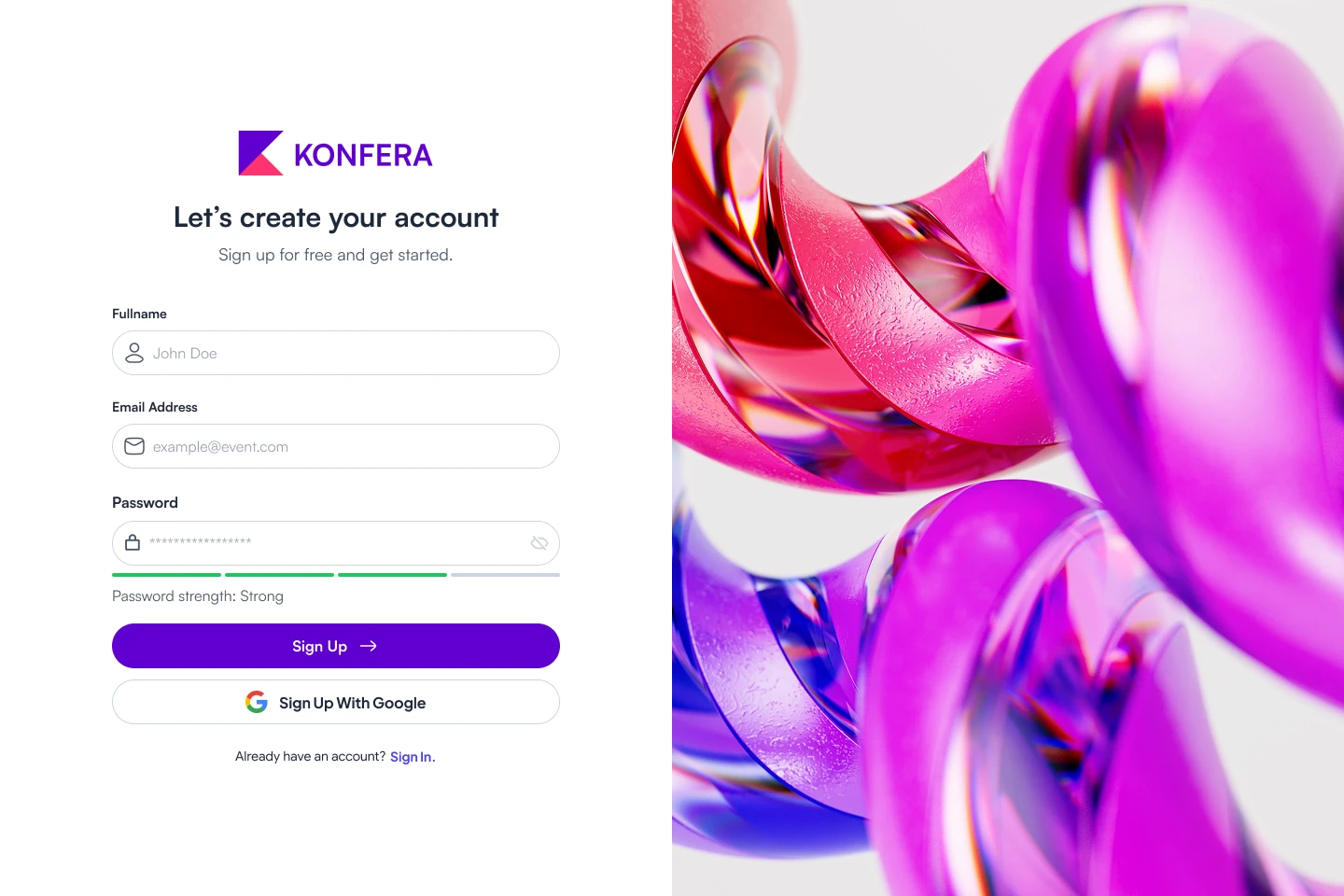
Created a scalable UI kit featuring accessible color palettes (for long-duration viewing) and a library of components for sponsors and speakers.
Process Stage
Usability Testing
Ran moderated sessions with a clickable prototype to observe how quickly organizers could publish an event and how intuitively attendees found the poll section.
Process Stage
Handover & Documentation
Finalized the design specs and created a comprehensive documentation handoff for the engineering team.
The Fix
Solution Summary
Konfera delivers a unified, mobile-first platform that seamlessly integrates event planning with live execution. This solution empowers organizers with a cohesive management ecosystem, eliminating the complexities of fragmented tools. For attendees, Konfera transforms the event experience from passive observation to active participation through its engagement-centric design. By prioritizing both 'lean-back' viewing and 'lean-forward' interaction, the platform directly addresses user behavior, while its modular architecture ensures scalability across diverse event formats, ultimately fostering higher engagement and operational efficiency.
05. Conclusion
The Impact
The final design successfully unified the "Planning" and "Participation" phases of events. By streamlining the sponsor management flow, we reduced the time-to-publish for organizers by 30%. Additionally, the integrated "Live Interaction" sidebar led to a significant increase in projected attendee participation rates. The project resulted in a scalable, high-performance platform that positions Konfera as a serious competitor in the event-tech space.
Learnings
This project deepened my expertise in designing for complex, multi-environment user experiences, particularly in balancing passive content consumption with active engagement. I honed my ability to translate abstract problem statements into actionable, mobile-first design solutions that prioritize user interaction and platform scalability. Furthermore, I refined my skills in developing robust modular design systems, reinforcing my understanding of their critical role in future-proofing product architecture and ensuring adaptability.